
Tuesday, October 13, 2026 The OT Team at Physio Inq
In this article
Summary
A functional capacity assessment (FCA) is a structured assessment of how a person’s disability affects everyday tasks at home, at work and in the community. These assessments are often completed by an occupational therapist, and the report gives the NDIA evidence about a participant’s support needs across six functional areas.
- The NDIS says a functional capacity assessment is not required for eligibility, but it can support an application.
- Six functional areas are assessed: mobility, communication, social interaction, learning, self-care and self-management.
- The NDIS lists occupational therapists, physiotherapists, psychologists and medical specialists as qualified assessors.
- An assessment involves an interview, observation of everyday tasks, and standardised assessment tools.
- According to the NDIS, an assessment takes 1 to 10 hours, not including report writing.
- Report writing can only be charged if agreed in advance, under the NDIS Pricing Arrangements.
- The report describes strengths, difficulties in each functional area, and recommended supports.
- The NDIA makes all funding decisions. No report can guarantee an outcome.
Do You Need a Functional Capacity Assessment?
Most people are asked for a functional capacity assessment (FCA) at one of two points: when they first apply for the NDIS, or ahead of a plan reassessment, which many people still call a plan review.
It isn’t compulsory. The NDIS says you don’t need a functional capacity assessment to be eligible for the scheme, but it can be useful evidence of how a permanent impairment reduces your functional capacity. The NDIA also uses the findings to decide what supports belong in a plan.
What Areas Does a Functional Capacity Assessment Cover?
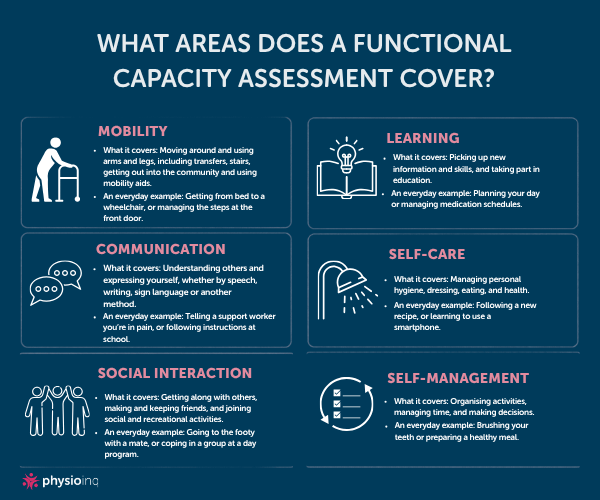
The NDIS groups everyday functioning into six areas (outlined below), and the assessing therapist looks at how a person manages in each one.
Most people have some areas where they cope well and others where they need a lot of help. The report should show both.
1 Mobility
What it covers: Moving around and using arms and legs, including transfers, stairs, getting out into the community and using mobility aids
An everyday example: Getting from bed to a wheelchair or managing the steps at the front door.
2 Communication
What it covers: Understanding others and expressing yourself, whether by speech, writing, sign language or another method.
An everyday example: Ability to understand and follow instructions or communicating an issue with a medical practitioner.
3 Social Interaction
What it covers: Getting along with others, making and keeping friends and joining social and recreational activities.
An everyday example: Going to the footy with a mate, or coping in a group on a day out.
4 Learning
What it covers: Picking up new information and skills and taking part in education.
An everyday example: Learning a new bus route or remembering the steps of a morning routine.
5 Self-care
What it covers: Personal care such as dressing, bathing, grooming, eating and toileting
An everyday example: Showering safety, or cutting up food at dinner
6 Self-management
What it covers: Organising daily life, making decisions and managing your own health
An everyday example: Keeping tracking of appointments and paying bills on time.
Who Carries Out a Functional Capacity Assessment?
Functional capacity assessments are carried out by qualified health professionals, most often occupational therapists. The NDIS lists occupational therapists, physiotherapists, psychologists and medical specialists as professionals who can complete one, as long as they’re qualified to make the assessment.
Occupational therapists complete many of these assessments because everyday function is the centre of their training. An OT looks at the person, the task and the place it happens, all at once.
What qualifications should the assessor have?
Anyone practising as an occupational therapist in Australia must be registered with the Occupational Therapy Board of Australia through AHPRA, and you can check a practitioner’s registration on AHPRA’s public register.
It’s also fair to ask whether the therapist regularly writes NDIS reports. At Physio Inq, functional capacity assessments are completed by AHPRA-registered occupational therapists, and our physiotherapists, speech pathologists or exercise physiologists can contribute when a participant already sees them.
For a child, parents are closely involved, and teachers or early childhood educators often provide input too.
What Happens During an OT Functional Capacity Assessment?
During an OT functional capacity assessment, the occupational therapist interviews the person and the people who support them, watches everyday tasks in real settings, and may use standardised assessment tools to measure function.
- Before the first visit
The OT confirms why the assessment is needed, such as an access request or plan reassessment, and, with your consent, gathers existing reports.
- The interview
Much of the first session is conversation: health history, living situation, a typical day and your goals. A parent, partner, support worker or support coordinator can join if that helps.
- Watching everyday tasks
The OT will usually ask to see some tasks, ideally where they normally happen. That might be making a cup of tea, a clothed walk-through of getting in and out of the shower, packing a school bag, or catching the bus to the shops. Seeing a task in your own space tells the OT far more than a description. Physio Inq’s occupational therapists can visit you at home or in the community, with telehealth sessions available for some conversations and follow-up.
- Standardised assessments
Many assessments include standardised tools, which are structured questionnaires or tests that score function in a consistent way. They sit alongside what the OT observes. The NDIS asks that functional evidence describe the tasks a person can and can’t do in each area, the type of support they need and how often, and whether tasks were observed, assessed or reported.
How Long Does a Functional Capacity Assessment Take?
A functional capacity assessment can take anywhere from 1 to 10 hours and depends on the person’s disability and the health professional completing it.
That time is often split across visits and doesn’t include report writing. A person with complex needs across several areas, or a child seen at home and at school, will usually take longer. Ask your therapist for an estimate before you start.
Under the NDIS Pricing Arrangements, providers can only charge for non-face-to-face work such as report writing if you’ve agreed to it in advance, usually in your service agreement.
Your plan manager or support coordinator, if you have one, can help you check how it fits within your budget.
What should I prepare for a functional capacity assessment?
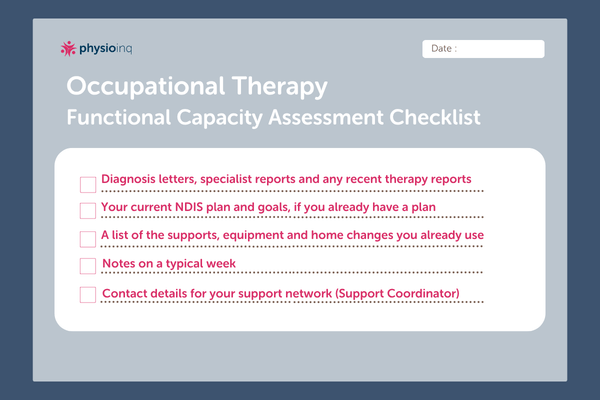
A little preparation helps the OT see the full picture. Useful things to have on hand include:
- diagnosis letters, specialist reports and any recent therapy reports
- your current NDIS plan and goals, if you already have a plan
- a list of the supports, equipment and home changes you already use
- notes on a typical week, especially what happens on harder days
- contact details for people who know you well, like a teacher, support worker or GP, if you’re happy for the OT to speak with them.
It’s tempting to show your best self on the day. Try to describe what usually happens instead. If you can shower on your own but need two hours on the couch to recover afterwards, the OT needs to hear that.
What Happens After the Functional Capacity Assessment?
After the functional capacity assessment, the occupational therapist writes a report describing the person’s strengths, the tasks they find difficult in each functional area, and the supports recommended to help. The NDIS uses this information to work out which supports a participant needs, which might include assistive technology, specific therapies or changes to a home or workplace.
You should receive a copy of the report. Read it before it goes anywhere and tell the OT if something doesn’t match your day-to-day life. It’s then provided to the NDIA with your access request or plan reassessment, either by you or, with your consent, by someone helping you.
The NDIA makes all decisions about eligibility and funding. A report is one piece of evidence. It can’t guarantee a particular outcome, and no provider can.
Is the NDIS changing how support needs are assessed?
Changes are coming, but not yet for most participants. The NDIS is moving to new framework planning, which includes a support needs assessment run by the NDIA. The Australian Government has delayed the rollout of new framework planning until 1 April 2027.
For questions about your own plan, contact the NDIS directly on 1800 800 110.
This information is current as of October 2026.
An FCA is Useful When it Captures Your Every Day
The more honestly an assessment captures your usual every day life, the more useful the FCA is for everyone reading it.


