Thursday, October 29, 2026 The OT Team at Physio Inq
In this article
Summary
- To be eligible for the NDIS, you must be younger than 65 when you apply, meet the residence requirements, and meet the disability or early intervention requirements.
- The NDIS isn’t means tested. Income and assets don’t affect eligibility.
- Children younger than 9 apply with help from an early childhood partner.
- Participants who turn 65 can choose to stay in the NDIS or move to aged care.
- To check your eligibility or apply, start with your local NDIS partner or call 1800 800 110.
- Access rules for new applicants are due to change from 1 January 2028.
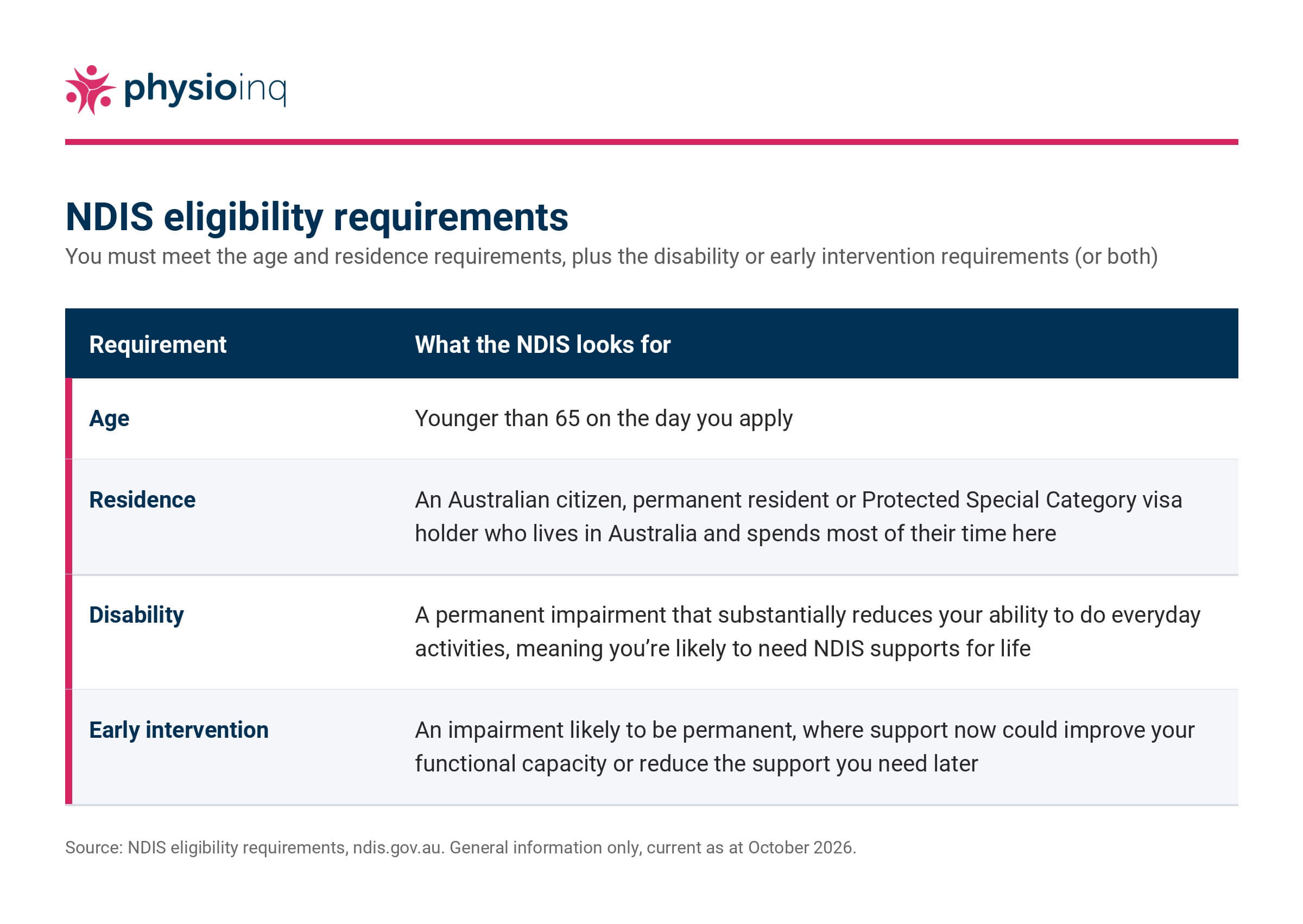
NDIS eligibility is based on three main requirements: you must be younger than 65 when you apply, meet the residence requirements, and meet the disability requirements, the early intervention requirements or both. Your income and assets aren’t considered, so the NDIS is not means tested.
What are the NDIS Eligibility Requirements?
The NDIS eligibility requirements cover your age, where you live, and how your impairment affects your daily life. You need to meet the age and residence requirements, plus the disability requirements, the early intervention requirements or both (Source: National Disability Insurance Agency).
The Disability Requirements
To meet the disability requirements, your disability must be caused by one or more impairments that are, or are likely to be, permanent. The impairment must substantially reduce your ability to do everyday tasks and affect your ability to work, study or take part in social life, and you’ll likely need NDIS supports for your lifetime.
“Substantially reduce” has a specific meaning. The NDIS looks for difficulty in at least one area (communicating, socialising, learning, moving around, looking after yourself or managing your life) that means you need disability-specific supports, such as a high level of help from other people or prescribed assistive technology, equipment or home modifications.
The NDIA may consider that this might look like a young adult with an acquired brain injury who needs daily prompting to plan meals and keep track of appointments. The NDIA looks at the impact on everyday life, not the diagnosis alone.
The Early Intervention Requirements
Early intervention is for people with an impairment that’s likely to be permanent, where getting support early could improve their functional capacity, stop it from getting worse, or build the skills of family and carers, and reduce the need for support later.
For children younger than 6, there’s a separate pathway. A child may be eligible if they have a developmental delay that substantially reduces their functional capacity compared with other children their age, and they need support from more than one professional working as a team for longer than 12 months.
The Residence Requirements
You must be an Australian citizen, a permanent resident or a Protected Special Category visa holder, and live in Australia. The NDIA can usually check this through your Centrelink record if you give consent.
Is the NDIS Means Tested?
No. The NDIS is not means tested, which means your income and assets don’t affect whether you’re eligible (Source: Parliament of Australia).
This surprises a lot of people, partly because Centrelink payments such as the Disability Support Pension work under separate rules. The NDIS looks at your disability and how it affects your daily life. Your salary, savings or whether you own a home aren’t part of that decision.
What Age Rules Apply to the NDIS?
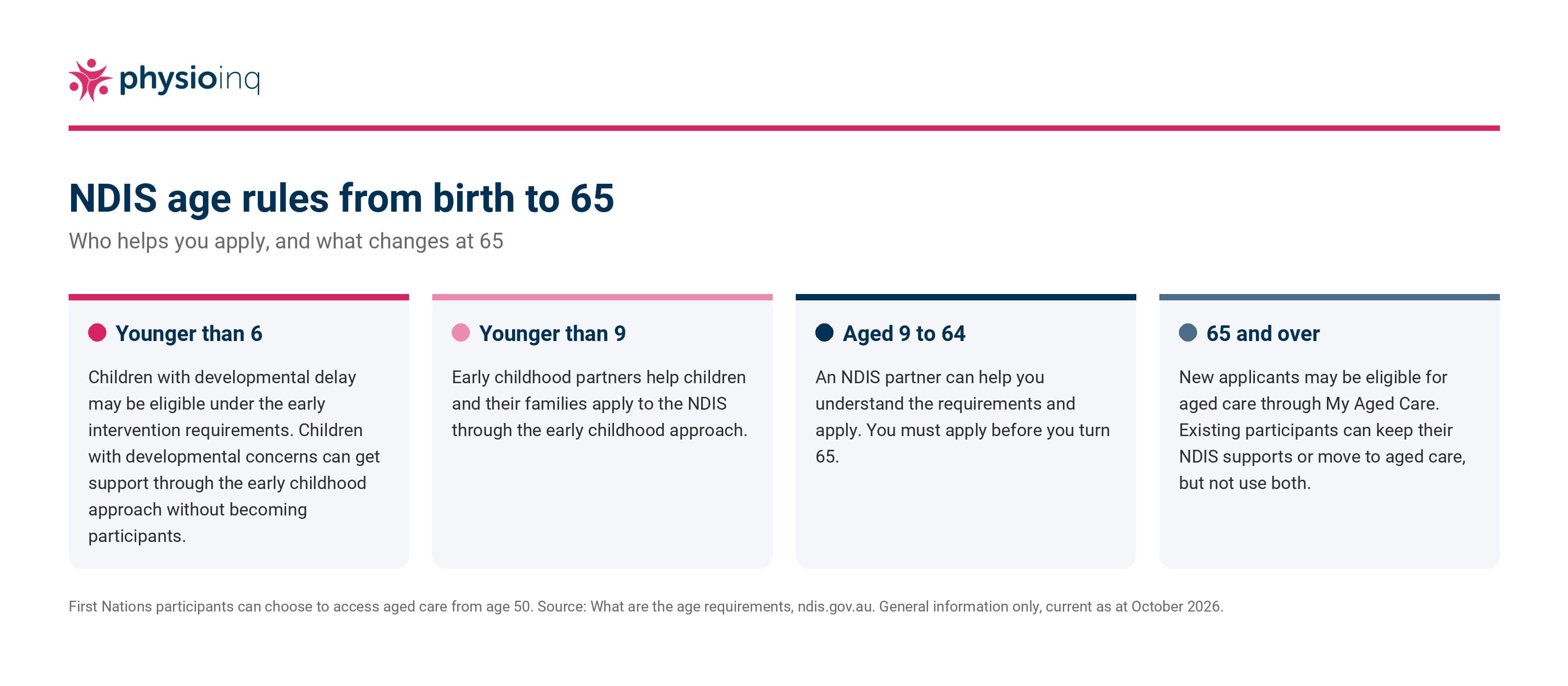
You must be younger than 65 on the day you apply to the NDIS. There’s no minimum age, so babies and young children can be eligible.
Children Younger Than 9
Early childhood partners help children younger than 9 and their families apply through the early childhood approach. Children younger than 6 with developmental concerns can also get support through this approach without becoming NDIS participants.
People Aged 9 to 64
An NDIS partner can help you understand the requirements and apply.
Turning 65
If you’re 65 or over and not already a participant, you can’t apply to the NDIS, but you may be eligible for aged care supports through My Aged Care. If you’re already an NDIS participant when you turn 65, you can choose to keep your NDIS supports or move to aged care, but you can’t use both at the same time. First Nations participants can choose to access aged care from age 50.
Where do I go to Check or Apply for the NDIS?
To check your NDIS eligibility or apply, start by contacting your local NDIS partner. If you’re not sure who that is, call the NDIS on 1800 800 110 and they’ll connect you.
The NDIS sets out the application in five steps:
- Meet your NDIS partner. This can be in person, by phone or online. They’ll talk through your situation and the evidence you’ll need.
- Gather evidence. Your treating health professional provides information about your impairment and how it affects you.
- Complete the application. Your partner can help, or you can fill in an access request form yourself.
- Submit it. Your partner can submit it for you, or you can use the NDIS online service hub, post it, or drop it at a local office.
- Wait for a decision. The NDIS will let you know within 90 days once your application and all your supporting evidence are in.
You can also take a support person, such as a family member or friend, to any meeting.
Supporting evidence can include a functional capacity assessment from an occupational therapist. Our guide to how the NDIS uses functional capacity assessments explains more, and you can learn how our NDIS occupational therapists work with people preparing applications.
What if I’m Not Eligible?
The NDIS will send a letter explaining why. You can ask for a review of the decision, and an NDIS partner can help you find community and mainstream supports. There’s no limit on how many times you can apply, so you can apply again if your situation changes or you have new evidence.
Is NDIS Eligibility Changing?
Yes, for people applying from 2028. Under new NDIS laws passed in August 2026, access to the scheme will be based on a standardised, evidence-based assessment of functional capacity.
People applying from 1 January 2028 will go through the new assessment, and existing participants will be reassessed progressively over about three years. The tools and thresholds are still being developed.
Until then, the current requirements in this article apply. This information is current as at October 2026.
Final Thoughts
If you meet the age and residence requirements but aren’t sure about the rest, talking to your local NDIS partner is the most direct way to find out where you stand.
Physio Inq is a registered NDIS provider working with self-managed, plan-managed and NDIA-managed participants.
Frequently Asked Questions (FAQs)
Related articles